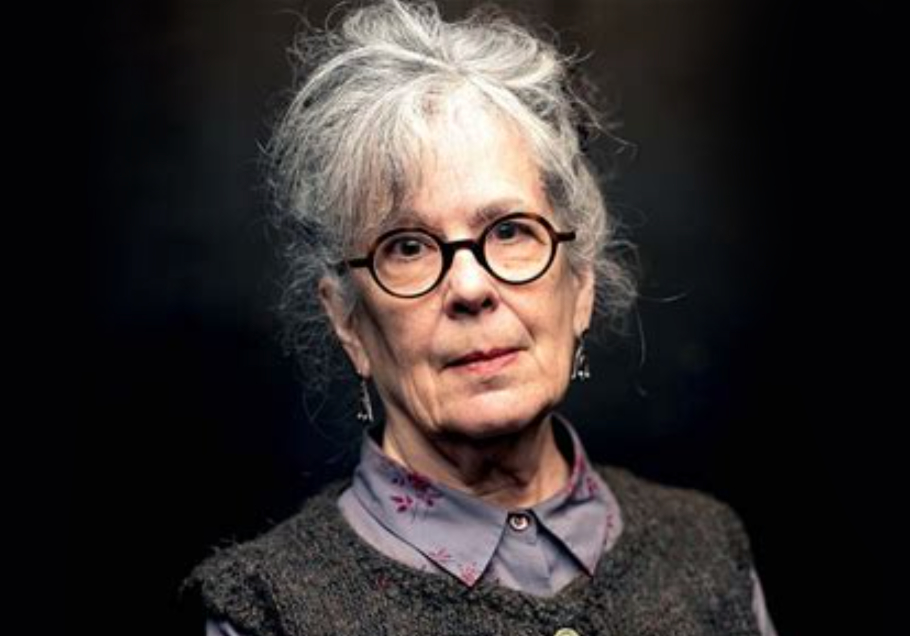
Christine Ross at Island School of Social Autonomy, Vis
Saša Savanović: Christine Ross is a literary theorist and a scholar of French political and cultural history teaching at New York University. Not anymore, I was thinking, oh, this must be some old biography that I found and then I’d be wrong, but I’m sorry.
But what is most important for us here, she’s the author of many books and the last two are especially important for ISSA: Communal Luxury and then The Communal Form. And I have to say that these two books have been very inspiring for what we are doing here at ISSA and provided us with a language to talk about our experience here actually, and that was very valuable. So with no further ado, let’s hear it from Christine Ross. Christine, please.
Christine Ross: Thank you. Thank you.
So I’m going to speak today about certain conflicts between land-based struggles and the state. I need a show of hands first of all. The main one I’ll be talking about is the ZAD at Notre-Dame-des-Landes in France. And I just want to know how familiar people are with this movement, how much detail I should go into. So could you raise your hands if you know more or less about what went down there? Okay, so good. There are some people here and I’ll go into a little bit of exposition when I get to that.
But I wanted to begin by saying that I’ve been interested for a long time in the processes of political memory. By that I mean: Why and when do certain moments from the past become vivid to us again or become useful or pertinent or just perceptible? And there’s nothing automatic about it. You can have a commemoration for some historical event and frequently commemorations just fall flat. At other times, suddenly some moment from the past will become utterly relevant and full of significance.
And so this is a bit abstract, but it’s the theoretical question that has guided my work for quite some time, which is looking at the political memory of great events in history of the left, like May ’68 or the Paris Commune. These are sort of French events, but they obviously exceed dramatically the national context. And it was, in fact, my work on the Paris Commune that became the occasion for an invitation down to the ZAD at Notre-Dame-des-Landes, outside of Nantes in France in 2015.
This was the longest lasting struggle in post-war French history. It went on for a good 50 years. And it was an attempt to block the construction of an international airport on farmland. And it was way back in the ’60s that the French state decided to build this airport. And at the time, a certain number of the farmers refused to sell their land. And so the whole project got delayed and then the state took a long nap and forgot about it for 20 years. And then suddenly, again, in about the year 2000, they woke up and they said, “Let’s build that airport.”
And in the meantime, the farmers were still there, but they knew they were weak. So they made a call for support and a number of occupiers and other people came down and began to occupy the zone to prevent the construction. And that became known as a ZAD, or a Zone à Défendre—a zone to defend. And they took the initials from the state bureaucracy’s idea for the site, a “zone d’aménagement différé”—a zone of deferred development. And they just switched it and said, “No, it’s a zone to defend.”
So this occupation of some very different people continued up until 2018 when they won. And Macron announced that the airport would not be built. I’m skipping huge events in that history, but that’s basically it.
Okay, so I was invited down there and I was asked to sort of think with them about the continuities and the discontinuities between what they were going through at the time in their occupation and what had happened in the 19th century during the Paris Commune. What were the possible relationships?
And now I’m not a philosopher, I’m not a political scientist. And my background, which is in literary studies, leads me to never start with a general concept like justice or something like that. But instead to start with specific scenes, specific situations, specific moments of political subjectivization—people coming into a kind of political subjectivity.
And when I wrote Communal Luxury, for example, I was trying to think about what the Paris Commune, if we could think of it as a kind of laboratory of political experimentation—Marx called it its “working existence.” So I wanted to show that the emancipatory processes that were going on in Paris at that time were just the everyday creations of ordinary people.
And in order to do that, I thought that I had to re-stage the event in the hopes that we’d be able to see something different or find some new language to talk about it. So when I went to Notre-Dame-des-Landes, it was a very interesting moment in the history of the movement. They had defeated a full-scale invasion on the part of the French army, who leveled all of their constructions, but they had rebuilt, and they had rebuilt with the help of supporters from all over France, and also beyond who had come in.
So at that moment, they were really looking for models or some kind of help to figure out how to inhabit the struggle and how to grow it. And some of them had turned to Chiapas, and they had gone to Mexico. And others were going back in history, and they had begun to focus on the Paris Commune, and especially the centrality of what I tried to talk about, which is the centrality of the aesthetic and the importance of the aesthetic to any kind of social transformation and even individual transformation.
So they began to see the Paris Commune as a kind of usable archive. And especially this idea of communal luxury, which is the central organizing allegory for me through which I began to refract several principal Commune practices.
I was really intrigued when I found that phrase, “communal luxury.” I was intrigued by the oxymoronic logic of it. I mean, because isn’t luxury by definition that which belongs to the few? How can you have communal luxury? And it’s really a figure for, among the Communards, it was a figure for a kind of human flourishing that was beyond material needs. So it was a way of thinking about useful production and equality in abundance—luxury that’s not founded on class division.
So I also thought it was such a useful kind of bridge to the present, in a way to reactivate debates about labor, about art in today’s political context. In a world that only now is very, very beginning to entertain the possibility of living better by producing less and by working and consuming and living differently. Beginning to consider a life where abundance, where subsistence becomes abundance, because we are not desperately accumulating.
So these are all key aspects of the commune form. And I’ll talk more about those aspects, but I wanted to stretch out the kind of larger historical argument that I was making regarding these kinds of territorial struggles, including along with the ZAD, others like Standing Rock in the Dakotas in the United States. Also in the United States, Stop Cop City. I don’t know if that has any kind of resonance for you, but it was an attempt—a bit like what happened in the Lützerath forest in Germany where people were living in the trees to block—in the case in the United States, it was the building of a police training ground in a virgin forest outside of Atlanta.
So it’s clear, what’s clear about these contemporary movements is that they are attempts, and very interesting attempts, to intervene frontally and directly against the capitalist destruction of the environment. But they also, I think, affect how we think about the recent past. And by the recent past, I sort of mean my lifetime, which would be the second half of the 20th century and up until today.
Now, how do they do this? I think that when you have a number of these kinds of situated occupational movements, they create a whole system of echoes back to the past and they give rise to a different kind of understanding of what counts for us in the recent past and what counts for us at all in history.
I don’t believe that the past enlightens the present. I don’t believe that the past is what the French call a “donneur de leçon”—a giver of lessons. I don’t think that the past really teaches us too much. It’s the present that rearranges our perception of the past and which brings to our memory certain sorts of precursor emancipatory events, at the same time that it erases all sorts of others.
And all of a sudden, things are rearranged so what we formally thought was important is now less pertinent, less alive for us today and worth forgetting. The present tells us what’s worth remembering and what’s worth forgetting.
Now, I think a lot of you will recognize these ideas as derived from Walter Benjamin, whose big idea is that it’s the present that determines the significance of the past. The responsibility of the present is actually enormous in relationship to the past. We are the ones who determine what meaning the past can have, which means that—and this is a reversal, especially in the ecological world—it means that we make revolution perhaps less for the future than for those who fought before us.
And in ecosocialism, you know, we’re always used to saying, “Well, we have to save the world for our children, we have to leave a better world for our children.” But what Benjamin says is, if the enemy triumphs, even the dead will not be saved. So our solidarity actually is with those who came before us and who fought.
So when the ZAD had its victory, all of a sudden, it became possible to see some events from the 1970s that everyone had forgotten about until that point. What happened in Japan—it was the ten-year struggle of peasants and farmers outside of Tokyo to block the building of the airport, a movement called Sanrizuka. Another in the south of France, the Larzac, and this was again one of these, what the Maoists would call a protracted struggle. It was a ten-year fight again by farmers to block the annexation of their land by the state to use as an army training ground.
And both of these suddenly became visible to me as really the defining conflicts of the era. They were the ones that were the most decisive and the most characteristic. And they involved bringing together strange groups of people who came in solidarity with the farmers. One of them won and one of them lost. The airport was built in Japan. The farmland in France was kept. But what’s important is that it really shifts our sense of the 1960s and ’70s and gives us another picture of that era as being the name for the moment when defending the conditions of life on the planet had to become conjugated with any kind of struggle for social justice. You had to do both. You had to think through the way in which defending the conditions of life itself had become the new horizon for any kind of political struggle.
So this view of the past was given to us, I think, by these contemporary struggles that also had the power to give new names to what we can recognize and remember about the recent past. And one of these names is something I’m calling the commune form.
And in order to think about that, I didn’t want to define, I didn’t want to start with a definition. I wanted to go back and look at these specific struggles again. And based on resituating them, come up with a postulate about the existence of a political form that gathered together all of these experiences.
And when I say “form,” I’m not talking about a model or something really rigid or pre-established. It’s much more of a process of working out against a shared enemy. But one where each attempt, each instantiation is intensely situational. It depends entirely—like in Sarajevo’s tour today, where you could see this very, very specific history of what has happened here on Vis—and how that history informs everything, a history that’s also an ecological history, evidently obviously.
So it’s a form that can’t unfold the same way everywhere across time or across space. And you know, Kropotkin thought of it as very much an archaic form. He thought it began with the French Revolution. But his main interesting thing that he said about it was that it’s the necessary setting for revolution, but it’s also the means of accomplishing it.
And I’ve always found this phrase really mind-blowing because what he’s actually saying is that there is nothing to revolution except making commons. And oddly enough, this is something that Marx, at various moments, especially when Marx is thinking about the Paris Commune, when he’s sort of most anarchist, he ends up saying something very similar to that. He says it’s the context for revolution and it’s also the content. So these are basically identical points of view.
But you know, what we’re talking about is something that is always linked to a specific space, a territory, a neighborhood, a specific milieu with all of its inhabitants, human and otherwise.
So when I wanted to think about it, I had to look at it, to try to specify the form as a kind of historian, go back to each one. And the book is actually an exercise in resituating and redramatizing a lot of these. Because the commune form cannot be abstract. It’s always built. And I think we’ll probably see this tomorrow. It’s really about building or creating spaces in the literal sense of the term.
Okay, I want to just briefly turn to three of the practices that I believe make up the political intelligence and effectiveness of this form.
And the first one is defense. And I think I was always struck by the fact that defense, to me, seems to generate a much stronger form of solidarity than does resistance. And when I try to figure out why that would be the case, because you know, you’re always called upon to resist and to resist. But if you begin—it’s a question of beginning. Where do you begin? If you begin with defense, you’re beginning with something that you love, that you cherish. You’re defending something that you already have, actually. Maybe only loosely. But it’s something that we love, that we cherish.
When we resist, we’re letting the state set the agenda. We’re attributing all of the power to the other side. And these are very different kinds of temporalities. With resistance, it’s almost as though the battle has been lost already. And with defense, you’re starting with a positivity.
You may begin by defending an unpolluted area or some farmland or a neighborhood. But by creating this territory and defending it, over time, this comes to include the entire collective project—the defense itself becomes what you are defending. In other words, a new form of defense takes form around the activity of the initial defense. We make our community by defending it.
The second practice that I isolated is appropriation. And when I began to think about appropriation, it gave me the opportunity to go back to a number of thinkers from the 1970s, like André Gorz, Murray Bookchin, Murray Amis, Félix Guattari, all of these people who came out of the ’60s essentially, but who got into ecological thinking through the path of everyday life, of considering the question and the problem of everyday life.
And the biggest figure for everyday life is of course, Henri Lefebvre. And he went far, I think, in talking about what he called appropriated spaces, which are really just spaces where desires and relations that are not reducible to economic imperatives have the ability to flourish.
And Lefebvre came up with one of the most amazing insights that, at least for me, I find it utterly amazing. I think about it all the time, because he argued that groups and individuals simply cannot constitute themselves as political subjects, as actors, political actors in their own lives, if they don’t produce a space. And by producing a space, he meant both a social space and a physical space.
They must produce such a space. They create it, they appropriate it, they manage it themselves. And if you need a practical definition of the commune form, that’s it, I would say that’s it. And the space that’s created, it’s not in the sense of a possession, but rather—and he used this word an oeuvre—more like a work of art, it’s a collective creation rather than a possession.
So appropriation is actually far more exigent than a mere idea or a theory. And it also points to, well, it presupposes some actual existential changes. I mean, you actually have to live differently.
Okay, the third is the question: well, who are these people who are living differently, who have appropriated a space and who are creating it themselves? Well, they’re not a political party, they’re not a social class. The commune form is far more inclusive than say a factory, since it includes non-humans, the aged, children, the unemployed.
And the people at the ZAD came up with a term for what they were, how they saw it and how they lived it really. They called it composition. And this was the creation, in their view, of a political community that was also living together. That’s what we’re really talking about.
Composition was a very pragmatic response to a perception that, again, already, Lefebvre had way back in the 1970s. He said, whenever there’s a struggle over land, it will unite the most different, diverse kinds of people that you could ever imagine. It’s really not a question of ideological purity, it’s not a question of anything except a shared common enemy. And so the battle lines are drawn very differently than say a battle over abstract ideas. And he said, when you fight over land, this will inevitably happen.
And when I went down, when I sat through these endless general assemblies down at the ZAD, I couldn’t believe what I was really looking at. There were the old dairy farmers. There were the more radical younger farmers. There were black bloc anarchists. There were nuns. There were petty bourgeois shopkeepers who lived nearby and didn’t want an airport. There were elected officials. There were lawyers. There were naturalists—naturalists who didn’t even believe in agriculture. There were people who were sort of anarcho-primitivists. I mean, it was the most amazing array of people. And they were living together, sharing a territory and a goal, which was to block the airport.
So composition is another name for solidarity across extreme diversity. And it was, I think it was really born with the ZAD. And it represents a massive investment in organizing life in common without the kinds of exclusions in the name of identity or ideology that we are all so familiar with in the history of the left. All of that kind of sectarianism that I lived through, for one.
So what composition shows is that it’s not only possible, but it’s actually desirable to work and ally with people who may have very different kinds of political codes. For example, neither violence nor non-violence was particularly fetishized. And it works to the extent that the enemy is clearly designated and a kind of equality is assumed across all of the different groups that make up the decision to act together.
And it stays a political community because people don’t necessarily merge. They don’t necessarily come to a kind of—they don’t try to convince each other of the superiority of their ways as opposed to others. But the most important factor about this idea of composition is the pragmatic way in which it works. It can work.
And the reason that the ZAD succeeded in, say, blocking the airport and why it also succeeded in existing for as long as it took to do that is that with so many different elements acting completely differently, it becomes very complicated for the state to intervene. You know, the old farmers had an enormous amount of social legitimacy. They could organize blockades with tractors. The naturalists had a great deal of scientific knowledge and could collect data on the endangered species on site. You had the practical experience of the anarchists, the squatters, the people who were familiar with the courts and could do any number of legal delays. The citizens groups, the punks and their improvisational unpredictability, the ability of the black bloc people to confront the police frontally—all of this combined to form an endlessly changing offensive that was very difficult for authorities to either conquer or pacify or recuperate.
It brings to mind Kropotkin’s idea about the importance of solidarity, where he said, you know, solidarity, it’s not an emotion, it’s not a feeling, it’s a strategy and it’s probably the most important revolutionary strategy that there is.
So, just to conclude, I wanted to say that these elements of the commune form probably make it the best method that we have to come to terms with the new social conditions. And I wanted to write—I set out and I did, I wrote a very short book. Because I think that when it comes to the destruction of the environment by capitalism, we already know absolutely everything. We know everything.
We probably have known everything since 1962 when Rachel Carson published Silent Spring. We may have already known everything since the 1920s and ’30s when Jacques Ellul and Charbonneau and those sort of people were writing. It’s possible we knew everything in the 1870s when people like Élisée Reclus and Kropotkin and the Communards that I wrote about were coming up with their own version of what was not then called ecological thought.
So, if we already know everything, then there’s no use in continuing to predict catastrophe or gather data or have round tables or repeat prophecies which will undoubtedly become fulfilled, that everything has become too complex for us to intervene in directly. What the ZAD at Notre-Dame-des-Landes showed us is that it’s actually very possible to seize hold of the machine and just yank it into reverse.
I’ll conclude with just a brief mention of something that we can discuss more in the workshop, which is the movement that’s come out organically from the ZAD, which some of you may be familiar with: Soulèvements de la Terre. It’s a movement which at this very moment is establishing a set of priorities and openly going on the offensive against the seizure of land in France and beyond.
But it’s made a specific decision to focus on the question of agricultural land for a few reasons. I think in the next 10 years—well, first of all, France is still 50% agricultural land. And in the next 10 years, 50% of that land will change hands as old farmers die or retire or get bought up. So this is a crucial period of time and they’ve decided to, as they put it, link up the land of the peasants with the planet of the ecologists.
So their battle really is with the agro-industrial complex and they’re putting together, I mean, quite an amazing sort of set of actions that came about from their own frustration with the climate marches before COVID and the idea that it was just far too abstract and that energy had to be brought down to earth and to specific places on earth, to specific parcels.
But it’s the form again that interests me because they have taken up aspects of the commune form. But what they’ve done is they’ve managed to solve the problem that the Communards themselves confronted in the 19th century, which was, in effect, a kind of isolation. Communards in Paris had no way of communicating with other communes that had sprung up in Marseille, in Lyon and other cities, and they had no way of communicating with any possible allies in the countryside.
And when the survivors of the Commune gathered in Switzerland and other places to talk about what had happened, the main problem that they isolated was this question of federation. How do you unite movements together that are locally based? How do situated local movements become federated into a more common ambition?
And I think this is something that Soulèvements de la Terre has, in effect, kind of solved, because what they do is they join forces with already existing local movements. For example, against certain polluters in certain areas or, in the southwest, the whole problem of water hoarding, which is going on massively now with the building of these giant reservoirs that are just for industrial farming and the water can’t be used by smaller farmers. It’s an amazing situation.
And what they do is they go and they sort of amplify these movements and bring them together through their own structures of communication. So they’ve really resolved the problem that eluded the Communards of the 19th century, this problem of federation, by creating a common horizon of situated struggles.
So I think I’ll stop here and I think we have time for some questions.
Saša Savanović: Thank you so much Christine. I will start with the first question, maybe second, and then I invite several more questions and then we’ll continue with the discussion in the workshop later—day after tomorrow, sorry. Yes. So my first question. Thank you Christine so much. The mic for questions is here. So you have to stand up and walk to it.
And yeah, my first question would be completely about the ZAD. About actually what happens next when we have defended land. What happens next? My impression was—I’m not that familiar with the ZAD. I only read mostly about it in your book. So my understanding was that there were attempts to return the land to private ownership. So what’s happening right now, do you know?
Christine Ross: Yeah, one of the reasons why the movement I mentioned—the Larzac, which was the struggle against the annexation by the army—it was 108 farm families in Roquefort and they were raising sheep for Roquefort cheese. And the reason why they came back into view really was that they had succeeded and so they had come up with a certain kind of legal, semi-legal sort of way of owning the land communally.
And so the ZAD began to try to look at that but they were not allowed to do that. So they—all they wanted to do was continue the kinds of communal farming that they had worked out with these older farmers. You know, these were really just young kids who were occupiers who had learned how to farm over time and they wanted to keep doing it. Not all of them wanted to keep doing it. Some of them left and some of them were left with a lot of resentments. So there was somewhat of a civil war at the end of things after they won.
But those who have stayed are still there and they’ve gotten these long-term leases of some kind. They had to get them as individuals but then they ignore all that. So they kept on with the communal farming. And then it was also those very people who, along with working with climate activists, Extinction Rebellion and others, and with the Confédération Paysanne and the radical farmers union—those were the three groups that invented Soulèvements de la Terre. So Soulèvements de la Terre is also an organic development that comes out of the ZAD.
Audience Member: Yeah, thank you. I have so many questions. So I don’t know where to start. I’ll go with what I’m most interested in and you will do what you want.
So I’m most interested about the common enemy. So in your examples and also in all of the examples that we are experiencing here in the Balkans, in land-grabbings, which means also in many cases water-grabbings—and this is increasingly happening. I mean, it wasn’t this obvious until a couple of years ago and I think now it’s so obvious that it’s painful.
And the common enemy is state and capital. My impression is always the common enemy. And yeah, I like how you put it that this is not a question of state versus energy, but state versus a different kind of political organization. But then we still have this state, which is so powerful. And so this is my always focus in these kinds of discussions: what to do with the state? And especially having in mind that it’s a nation state. And we cannot ignore it.
I mean, now speaking personally, let’s say it’s not something that either we want to conquer. That’s my personal view, yeah, because I don’t believe it can produce anything but what it’s already producing. So how do we—I mean, leave it behind somehow or, you know, like, what do you think, how do we deal with the state? Is it pragmatically or yeah?
Christine Ross: It’s a tough question. I know. It’s just so different in every situation, you know, because there is, for example, you know, this whole period of time when the state forgot it was going to build an airport—that was an incredible moment for these people because, you know, there are times when the state takes a nap, you know, and you can get some things done.
But other than that, in various situations, it’s that old idea of dual power, you know, or what you all are doing here. I mean, you just start building next to it or in an attempt to render it redundant or render it not necessary. But this means really for people becoming much more creative.
And there, I think, this is the problem. It has to do with people realizing that there’s an incredible amount of pleasure to be found in having some kind of say over your own future. And this is so unknown to most people now. There’s a kind of pleasure that doesn’t come from next day delivery or, you know, all of the stuff that’s offered to us by capitalist culture.
So, I was thinking about this because I was reading a statement by the Minister of Transport in France. This had to do with another struggle that’s going on right now that has to do with building a highway between Toulouse and a small town outside of Toulouse and wrecking just acres and acres of forest and farmland to build this highway when there’s already a working highway right there, you know. All these airports are redundant, you know. The Narita in Japan was not necessary. There was already a working international airport in Tokyo.
So anyway, in relationship to this current thing, the Minister of Transport said, “We will never allow another ZAD to be built in France. Never.” Then he said, “The ZAD is not a festive gathering. It is not a joyous something or other—no, it’s a fundamental assault on the laws of property.”
And I was thinking about that and of course his second part of his statement is true. But what was really aggravating to him or scary to him was the first part—the idea of a kind of pleasure that was not state-sponsored or capitalist-sponsored. And that, you know, was very much there. And I think that’s really the way to kind of go about presenting things.